Wednesday, May 8, 2013

Stuff's Gettin' Real...

by Jas Faulkner

Hi!  My name is Jas Faulkner and this is my second season writing for the ENFM blog. Like many of you, I am continually learning ways to live a cleaner, greener life. Over the next six months we'll explore what the market has to offer.  We'll also look at the history and culture behind farmers' markets, local foodways, and   other aspects of the production and the politics of food in North America.  But first, I need to talk to you about something very important.

 Consider this a call to farms.  

In the past you may have decided to support your local farmers' market based on some abstract principle. You may have done it because it was an emotional callback to a time when nearly every family had someone who lived on a working farm.  You may remember the sweet smell of warm produce picked earlier that day and then lovingly prepared as family shared stories of the past and planned for the future.

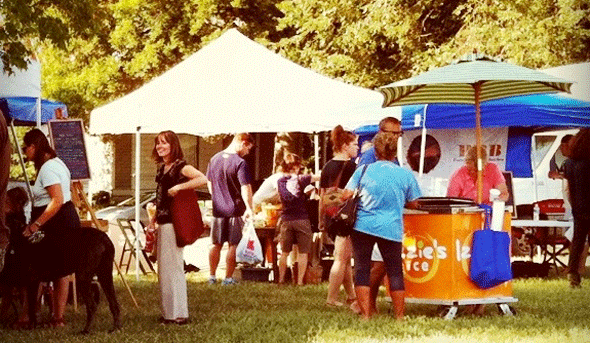
You may have made a weekly trek to The East Nashville Farmer's Market because it's a fun thing to do.  It's a way to meet some nice people who are passionate about growing safe, nutritious food for your community.  Your friends and neighbors are there.  It's a lovely, bucolic space in the heart of the city where children dance to live music and artisans and their families share everything from cheese to salsa to pie to hummus.

If someone asked you why you visit The ENFM, you might have some vaguely pleasant answers about how it makes you feel good. And that's a good thing. You know?  Given the choice, I support local producers and merchants for nearly everything I use in my kitchen and elsewhere. I do a price and availability check at The Turnip Truck and Center of Symmetry first and now that market season is upon us, ::deep breath:: I have another local place to look for what I need (or sometimes just want.)

Here's the thing, and it's kind of a big thing, er, deal:  Stuff's gettin' real.  We can't take for granted that these sources will be around if we don't support them. If you care about preserving Tennessee's agrarian heritage, if you care about what goes into your pantry, if you want to keep something that has become a vital part of community life, you'll understand why it is important to support The East Nashville Farmers' Market.

It only happens on Wednesdays at those magic hours from 3:30 to 6:30 at 10th and Russell. Come on down and meet your farmer!


Monday, March 18, 2013

Go For The Real Deal: Producer Operated Farmers' Markets

by Jas Faulkner
How much do you trust the people who supply the grocery store you support or the kitchen manager of your favorite restaurant to provide food that is safe?  

In a very telling incident, food journalist Michael Pollan visited a farmer who grew potatoes for McDonald's french fries.  During the interview, Pollan asked the farmer if he fed the potatoes to his own family and the answer was an emphatic, No!' The farmer grew his own organic spuds to feed his own clan.  Later in the story, Michael asked for a drink of water and was warned away from filling his glass at the tap.  The farmer's wife explained that the local water was full of pesticides and they bought bottled water to drink.

That was a sad example of a farmer knowing his or her food, and also knowing that he didn't want to eat it. It brings up an interesting question of  how well the people behind the tables at farmer's markets know their produce. Can they tell you where the seeds came from or whether their stock was exposed to chemicals that might remain not only on t he outside of the fruits and vegetables, but have permeated the flesh?  Did those potatoes come from a county away?  A time zone away?  Did they come from another continent altogether?

Once upon a time...
 A farmers' market was exactly what the title suggested.  It was a place where people who grew fruits and vegetables or raised animals for meat could sell what they raised. The advantage was one of both quality and trust. There was a greater sense of accountability on the part of the producers and customers knew that they had a responsibility to support farmers if they wanted to buy food that was locally produced by people they trusted. This worked well because most metropolitan areas were surrounded by farmland. There were enough farmers to feed everyone who cared enough to maintain a locally centered food economy.

As more people moved to the city and the land surrounding those urban areas was devoted to housing, people got comfortable with the idea of buying everything they ate from large corporate producers who created factory-perfect food-like stuff that could come from anywhere. Zero plotline development and the loss of connection to family traditions such as the household kitchen garden cause people to lose a sense of what it meant to eat with the seasons.  The demand for shipped in produce grew and with it, the loss of seasonal eating except for certain holidays.

Over time, people began to miss the feel of buying from a farmers' market, so they sought out places where they hoped to buy fresh, in-season produce.  One thing many of these shoppers didn't think to ask was: "Where did it come from?"


Not All Farmers' Markets Are Equal

A farmers' market is a farmers marker is a farmers market?  Right?  Well, on the surface, that might be true.  The open air ambiance, the smell-of-the-week of whatever is in season, the atmosphere that makes it feel more like a large outdoor party; these are all things that draw people to farmers markets.

So what is the difference and why does it matter?


There are two different kinds of farmers' markets.  The first is the  traditional market where farmers sell what they raise.  The second, and sadly more common in many urban areas, is really more of a reseller's marketplace.  these people often go to food wholesalers and buy large lots of produce.  In some rare cases, they might know the person they are buying from without ever actually seeing where their wares come from.

When you buy from a market that allows resellers,  you run the risk of buying food that might have been raised in less than ideal circumstances. Do you or they know exactly what into the items you're considering for your pantry?  Chances are the person behind the cash box knows exactly as much as you do, which is nothing or pretty close to it. Is that a risk you want to take?

Know Your Farmer
Traditional farmers' markets are worth the investment of time and money.  Eating locally means you are more likely to eat in season and eat in a way that will contribute to your overall good health.  It means that you have the confidence of knowledge and the power to make your own choices about what you put into your body.  It means that you help keep the local economy robust and  food sources close by which is a smart, sustainable way to feed your community.

Most important of all, know your farmers means that you are buying from people who are selling you the same things they are feeding their own families. They get  your support of their hopes and dreams and you get the benefit of years of agricultural education, family experience, and strong personal values that go into organic family farming.

So the next time you think about visiting a farmers' market, look, ask, and make informed choices. Your local farmers will thank you for it!


Wednesday, October 24, 2012

Feeding Ourselves, Each Other

by Jas Faulkner 

During a conversation about the division between acts that are sacred and profane, the act of feeding oneself and others was something that quite surprisingly had the room divided. The profane folks saw the enterprise as something purely physical, for them it came down to the mundane business of  manufacturing and distributing fuel for the human animal. The profane folks were incredibly prosaic about it.  Food goes in, people stay alive at least and are productive at best. I couldn't help but wonder if their response to Soylent Green would have been a shrug and a mumbled response about it being less messy than composting.

The other side, which in the interest of disclosure, included me, saw things a little differently. The practical aspects are undeniable.  In order for it to really work in the long run, there has to be something deeper at work, an awareness of how truly interconnected we are.  This starts with the people who raise our food and continues through those who carry out its distribution and preparation. Beyond the obvious requirements of healthy soil, safe water, and hard work, the not so obvious components are knowledge, trust, and the recognition that we are nurturing, respecting and supporting each other at every step in the process.

Over the course of the season, I have written about the need to know your food sources and the importance of understanding the nature of how they produce what you put on the table.  Now I would like to talk about the table itself.  I'll offer this precis:  Nothing I'm going to say is particularly new.  The subject has been approached by thinkers and observers as diverse as Thomas Merton, John Robbins, Rose Nader, Ward Goodenough, Francis Moore, Lappe, Jean Anthelme Brillat-Savarin, Deb Duchon, Tony Campolo, Jane Goodall, Matthew Fox, Michael Pollan, Marion Cunningham...I could go on for at least a page worth of names.  Let's just say I'm standing on the shoulders of giants.

All of those people recognized how important the act of feeding yourself and your family could be. It is fueling the body.  It is also a promise we give to ourselves and each other that we are caring enough to do what is right and what is best when we make choices about food.  Preparation should be a continuing learning experience for both ourselves and if we share a home with someone, the people we live with. Mindfulness about preparation means respecting the sacrifices that go into the ingredients you use. If you eat meat, it is the recognition of the life that was sacrificed to provide that protein. For everything, it is gratitude to the farmers who decide to make a professional  life borne of either family tradition or an innate dedication to the discipline.

As hard as it can be at times, really as hard as it has been for North American families since the post-war boom of the 1940s', we need to extend that to a shared time around the table. If the act of choice and preparation are bound in trust, the culmination of that is the meal itself.  So much of our consumption happens when we are on the run.  Even if we spend quiet time in the early morning making sure we are prepared to meet mealtimes with healthy food throughout the say, there is still the need for the community of the table. Sharing food is a big part of it, but it is also where we share more of ourselves.

The meal together, whether it is in the morning before we go meet the day or as we close ourselves in for the night is the time when we all get to know each other all over again.  As we are touched by the world, we grow and change.  To miss out on that shared time without television, without outside distractions, is to miss out on those developments, small and large that make us who we are at every age.  We are bonded by what we share when we are most vulnerable,and that is when we settle in and open up to those closest to us.

So much of what we do is segregated by age, interests and other ways we identify ourselves that the communal table should be a daily thing instead of a rare, special happenstance. Think of it as voting everyone back on to the island. It's as easy as passing the peas and listening.

Wednesday, October 17, 2012

Winter CSAs: A Little Bit of Fresh Heaven When the Days Get Shorter

by Jas Faulkner 

After today, there will be two more East Nashville Farmers Markets and then the corner of Tenth and Russell becomes a quiet, green square of grass until next Spring.  For some market regulars, Wednesday afternoon at the market is the place to pick up dinner and a few extras for the week.  For others, it is the source of fresh food now and food to can, freeze, dehydrate and fill a root cellar for later.

Here's the thing:  Those farmers?  The ones you pick up a CSA box, bag or basket from?  Many of them are offering CSA subscriptions for the winter months.

Okay, do not flip over to Facebook yet.  Hear me out.   A CSA share does not mean you're destined to get a box full of butternut squash and a couple of collard leaves.*  Here is a list of some of the things you can expect to find in your share: lettuce, kale, broccoli, cabbage, sweet potatoes, winter squash, turnips, all things good, green and leafy, onions and tatsoi.

Tatsoi?  Really?  You've never heard of tatsoi?

Excuse me for a moment.

I'm back.  This is tatsoi:


It is the mildest, greenest, tastiest leafy vegetable on the planet.  You really want to take the chance that you're going to miss out on this because you might make it to another farmers market the week or two one of the rare actual farmers -as opposed to a reseller- offers up their tatsoi for sale?  Really?

Double checking here.  You're going to miss out on Tatsoi?

John Goodman is disappointed.
So is this rabbit.
Of course you CAN remedy this by talking to your favorite vendor today to see if they're going to offer a winter CSA.  All you have to do is ask.  You might be surprised, not only by the fact that there is a lot of good stuff available in the winter, but that it's as easy to get and reasonably priced.  Do it today!

These crabby woodland creatures missed out on getting winter CSA shares!

Just a quick note:  Next week (10/24) the ENFM will be hosting a Random Acts of Reading bookflash!  Have some books you are getting a little tired of? Want to find something new to read? Check out Random Acts of Reading tomorrow (10/18) for more details!


*Yes, I typed "leafs" and nearly left it that way.  Hockey much, Jas?

Monday, October 8, 2012

Fall Fest: Wednesday! Wednesday! Wednesday! Come Touch a Tractor!


By Jas Faulkner 


Looking for a cheep thrill this Wednesday?  Why not take your offspring to pet a chicken or touch a tractor at East Nashville Farmers Market?

Now in its sixth year, the ENFM Fall Fest is a great way to see what fresh fare is available from the vendors and spend some low-tech, no-pressure time getting your little rock-and-rollers to consider taking a walk on the country side. 

 According to event coordinator and market director Amy Delvin Tavalin, the event, which started out as a part of the much smaller market in the parking lot of The Turnip Truck, had seven vendors, a bluegrass band and a petting zoo.  

"This is the 6th year of the Fall Fest, we've had one every year that the market has been open, but it gets bigger every year!"

With the foliage changing colors and the weather getting milder, this is the perfect time to come see what you've been missing if you have not yet made it to the magic at South Tenth Street every Wednesday afternoon.  Even if you don't have the excuse of a household small fry with a yen for some face time with a John Deere, there are plenty of events and vendors to delight your senses and inspire your inner Emeril. 

Aside form the kid-oriented events: the petting zoo, touch-a-tractor, and pumpkin- and punkin, er, face painting; each vendor is going to decorate their stand, so you might just pick up some ideas for your own fall decor from our talented crowd of farmers and artisans.  Michael Martin of Whole Foods will be on hand with a chef demonstration that is sure to please the pickiest eater. 

Many newcomers to local fare might not realize how much is available in the the fall. While the choices differ from the summer months, there is still a diversity of good for you and good to eat produce to look forward to trying.    According to Amy Delvin Tavalin, "vegetables will be changing in the remaining weeks- cooler weather brings back the leafy greens along with winter squash, pumpkins,sweet potatoes, broccoli, cauliflower, radish, turnips,  and beets.Some vendors will have fall herbs, flowers, and seasonal desserts as well! 

For Tavalin, the idea of celebrating Autumn in East Nashville is an easy choice:

There's something about the changing of the seasons that inspires community. We're hoping to have the East Nashville community out to help us celebrate Fall and the changes that it brings. Pumpkins, gourds, leafy greens, winter squashes, sweet potatoes, cabbage, broccoli, cauliflower will be making their way in, and that nip in the air that October brings will invite folks to try hot cider, coffee and pie. 

Do you really want to miss this?  That's what I thought. Come out, sample some good stuff and bring more healthy goodies home.  You'll be glad you did! 


Wednesday, October 3, 2012

Hog Killing Time

by Jas Faulkner 

Reminder: Next week the ENFM will feature their annual Fall Festival!  Check here on Monday, October 7th for more information.


Readers outside of the Nashville area probably picture my hometown as a more of an overgrown small town than the cosmopolitan metropolis that it really is.  Like many entertainment industry hubs, the best way to describe the population of Nashville is: "nearly everybody here is from someplace else."  

This demographic shift has contributed to some big changes in Music City's culinary diversity.  Are you a displaced New Yorker looking for a taste of home? There's a restaurant near Vanderbilt called Noshville that offers deli food Big Apple Style. Nolensville Road is a culinary UN, with establishments representing the foodways of nearly every continent. No matter where a Nashvillian may hail from, there is something here that will give them a touch of "back home."   My home city's culinary profile is not just about bringing everything from there to here. Nashville Originals is an organization devoted to promoting local restaurants whose chefs work at the edge of the continually evolving definition of Nashville cuisine.

Another aspect of this change can be found in our recognition of the holiday calendar in terms of the accepted wisdom of when and to a much lesser degree what is eaten at certain times of the year. The ways in which Middle Tennesseans eat, especially during the winter holidays, is getting less distinguishable from the rest of the country. What many transplants don't realize is that divergent regional traditions in the holiday bill of fare were still the norm less than a century ago.

Thanksgiving is a classic example of the way regional differences can affect what's on the menu.  The Thanksgiving pictured by Norman Rockwell is a version that has its roots in the Northeast.  While the custom of having roast turkey, dressing and cranberries is pretty common across the US now, in the first half of the Twentieth Century, Thanksgiving was considerably different for many Tennesseans, especially those who still lived in rural areas.

The cooler weather meant that many families were devoting the time off from school and work to prepare for the winter months. The last of the produce was canned, frozen, and stored in cellars and the next step, slaughtering and parceling the meat usually occurred in November.  Often referred to as "hog killing time," the long Thanksgiving weekend usually entailed families gathering to slaughter livestock and then butcher the carcass.

This was, well, actually it is a communal process.  Once the animal is killed and the meat is cut, much of it is either sent into a deep freeze or a smokehouse.  Meals center around this activity and the recreational/subsistence hunting that takes place once the livestock chores are completed.  If there is deer or turkey meat to be prepared, a similar process ensues.

Because of this, many families might enjoy a pork roast and vegetables for Thanksgiving dinner (midday) or supper that evening.  The next day, the traditional breakfast would consist of tenderloin and biscuits, gravy, grits, fried potatoes and eggs. Tabletop condiments for breakfast usually included molasses, apple butter, butter, and home canned or frozen fruit.  For the rest of the weekend, there might be a cookout, but for the most part, meals were made from leftovers.

Did those 20th Century Tennesseans ever feel their holiday was lacking?  Not really.  It was a time for fun, telling family stories and yes, giving thanks.  According to one person who remembers those Autumn days fondly:

"But then we always did that, give thanks.  Getting up in the morning is as much a reason for knowing there  would be food on the table and a roof over our heads.  We were always thankful for both every day!"


Wednesday, September 26, 2012

Waste Not, Want Not

by Jas Faulkner

Waste not, want not.  Few would argue with the wisdom of such a principle, but even fewer fully understand the extent to which it can be carried out in household, much less kitchen management. The idea of low to no household commodities waste is sometimes dismissed as a quaint, antiquated holdover from grandparents and great-grandparents who survived the economic depression that hit the US between World Wars.  To many, it has been rebranded.  Gramma's frugality now bears the shiny new title, "sustainable living."

Is this a bad thing?  Absolutely not. In fact, to cadge a phrase from Martha Stewart, it is a very good thing.

Like organic food production, upcycling/recycling/using every bit of everything from snout to tail is a shiny new concept surrounding older ways that have been kept alive by choice and circumstance.  Those who live in less developed parts of the United States, citizens of aboriginal North American reservations, urban dwellers who understand the need for commodities to be used up of because of the lack of space and resources for disposal, and yes, many college students.

Think you're already using everything in every way possible?  Here's a quick way to tell if that is the case:  What does your curb look like on the days the garbage truck rolls through?  If you're doing everything you should be doing, your average household waste for that week should fit into one, maybe two t-shirt bags.

No? Are you still screaming (on the inside, where it counts) "Hefty! Hefty! Hefty!" as you trudge to the sidewalk?   It's okay.  We all do it sometimes. If you're doing it every week, you need to know that it is possible to wean your wastebaskets and trash cans from a steady diet of stuff that could be recycled into rugs, clothing, planters and even fashionable vegan shoes. Keep in mind this kind of change does not have to be a zero sum proposition.  You can start small.  Just start!

Let me help you out with this.  Do you eat Annie's Mac 'n Cheese?  The next time you're in the mood for comfort food and you tear open a package, ad you're waiting for the water to boil, take a look at the box. Yes, the bunny is cute and the bumper sticker offer that has been open since I was an undergraduate is still on the side. What you'll also find are tips on how to reuse that box before it finally ends up in your recycling bin.

Low to no waste isn't limited to paper and plastic.  Take a look at that pretty yellow oval in your CSA box.  For those of you who have never tried spaghetti squash, you're missing out.  It has the texture and taste of a good veggie pasta prepared al dente the way the school cafeteria ladies never intended. Don't let this tasty, healthy treat go to waste.

I consulted with my friends and fellow veggie fans, Sylvia and Bill  Red Eagle, on the best ways to use every bit of a spaghetti squash.  Starting from the inside out:

Seeds: The tangle of seeds and mushy, fibrous stuff needs to be removed before the rest of it can be cooked.   Once you've scooped it out, begin to knead it and you'll find the seeds will start to fall out.  Rinse them off, buff them barely dry with a clean dishtowel and then spread them out on a cookie sheet.

They're great plain or you can season them with any of the following: cayenne, chili powder, garlic salt, grated parm or asiago, or cinnamon and a little sugar or (a tiny, tiny amount of) stevia if prefer a sweet snack.  Once you've seasoned them or not, pop the tray in an oven set at 275 degrees for five to ten minutes or until the seeds are dry, crisp, and slide around.

This recipe works with any squash or pumpkin seed and those seeds, called pepitas by my father's people (who also refer to corn as maiz, go figure...) are a great source of protein and fiber.  One cautionary note:  they are very rich in Omega-6, which do weird things to Omega-3s, which you and I and everyone we know  needs.  So, as Cookie Monster might say, they're probably best eaten as a sometimes snack when you happen to be cooking a winter squash.

Flesh:  Some people boil it, some steam it, the Red Eagles like to cut it in half and bake it flesh side down until the fibers pull away into "noodles".  They like it as a side with butter, salt and a little sauteed garlic or garlic scapes when they're in season or as a "chili mac" when the weather in Ft. Worth gets a little colder.  I like it topped with a good "tom 'n three plus" marinara ( tomatoes, onions, garlic, peppers plus herbs and wine).

The Skin, Stem and Seed Muck:  All of it composts beautifully.  If you have established a place for birds and other neighbor critters to visit and grab a bite, you'll find that they see the seed muck is like, the best snack ever to squirrels, titmice and black capped chickadees.

So, let's review.  You started with this ornery hard thing that you wondered if you could use as part of a centerpiece or a decoration for the guest book table at church and now you have a tasty snack, a great meal that is light on the carbs, and some good karma from feeding your fellow earthlings.  Best of all, none of that ended up in the trash.

Hungry for more?  Talk to your local farmer about their favorite ways to use winter squash.  You might want to check out these recipes by two of my favorite chefs/foodways preservation advocates:

Emeril Lagasse's herbed spaghetti squash is an easy dish after a rushed day.

Rick Bayless' "Worlds Greatest Chili" includes winter squash as part of his refit of a home kitchen classic.

Bon appetit and keep green!

Wednesday, September 19, 2012

Good Guys Wear Blue Corduroy

by Jas Faulkner 


Theirs was the kind of cool that defied the usual taxonomic constraints of senior high school hierarchies.  Laconic and for the most part unworried by the usual sturm and dang that plagued teens determined to make those three years the BEST years of their lives by being the BEST class EVER, they moved through life at their own pace.  Small, close-knit groups of clean-shaven, baby-faced boys and smartly turned out young women walked the hallways, self possessed, impervious to the handfull of students who sometimes catcalled them without fully understanding their own concomitant loathing and envy. They followed an agenda that addressed few of the concerns of the so-called lives that flittered inside the snow-globe insularity of high school's social order.  The timetable and values they followed were those of the real world, the world beyond classrooms.

 What set them apart visually from other self-contained groups, the kids who would grow up to work for Cessna and Boeing and IBM and NASA, were the jackets. Those zippered, cobalt blue, wide wale corduroy jackets with the oddly old-fashioned embroidered logos on the crest and back identified members of FFA, the Future Farmers of America.  They were worn with pride by students who were either continuing a family tradition of farming and ranching or contemplating a move beyond the suburban nine to five careers of their parents.

Actually, there are still kids getting, no, earning those jackets every year.  According to the latest figures, over half a million young people ages twelve and up have answered the call to learn agricultural science.  Many of them will be in FFA until graduation and then move on to other things.  Aside from the artifacts and memories, they'll have a deeper understanding of how important it is to have a vital, thriving agricultural sector within the economic makeup of our country.  They will respect how important it is to not take for granted the labor, the availability of resources, and the significance of knowledge and commitment to farming that keeps everyone fed and secure.

Food security is not just organizational lip service.  It is a very real value that is at least three shifts each to helping assemble meals for distribution to areas where hunger is a problem.  Their goal this year is to assemble one million meals as part of their Rally To Fight Hunger.  This initiative not only employs young hands, it engages hearts and minds as attendees learn more about the root causes and possible solutions to food scarcity on both local and global levels.

Those who choose to follow the creed* into adulthood by stepping into the family business or pursuing agriculture as a major in college find that FFA continues to offer support.   The organisation provides scholarships and opportunities for mentoring and leadership either in the capacity of apprenticeship or as an educator for the next generation of Future Farmers.

To the many children who come together from diverse backgrounds to be a part of FFA, those blue jackets are not just a quaint fashion statement to be discarded when other inclinations hold a greater attraction.  They represent a serious commitment to the kind of stewardship that goes beyond youthful promises for short term involvement.  When it's done right, FFA is life-changing.  It is their chance to be part of something good, something bigger than themselves that has fostered personal growth since that first gathering of teachers and students at Kansas City in 1928. It is, in the truest sense of the expression, a way for  young people to be empowered by knowledge and to gain confidence in their abilities as agents of positive change for the future.

Want to know more?  Visit the FFA's homepage at: https://www.ffa.org.


*The FFA Creed:

I believe in the future of agriculture, with a faith born not of words but of deeds - achievements won by the present and past generations of agriculturists; in the promise of better days through better ways, even as the better things we now enjoy have come to us from the struggles of former years.
I believe that to live and work on a good farm or to be engaged in other agricultural pursuits, is pleasant as well as challenging; for I know the joys and discomforts of agricultural life and hold an inborn fondness for those associations which, even in hours of discouragement I cannot deny.
I believe in leadership from ourselves and respect from others. I believe in my own ability to work efficiently and think clearly, with such knowledge and skill as I can secure, and in the ability of progressive agriculturalists to serve our own and the public interest in producing and marketing the product of our toil.
I believe in less dependence on begging and more power in bargaining; in the life abundant and enough honest wealth to help make it so-for others as well as myself; in less need for charity and more of it when needed; in being happy myself and playing square with those whose happiness depends upon me.
I believe that American agriculture can and will hold true to the best traditions of our national life and that I can exert an influence in my home and community which will stand solid for my part in that inspiring task.


Wednesday, September 12, 2012

September 12th and Victory Gardens

by Jas Faulkner


September Twelfth always has a tinge of emotional hangover to it.  As each succeeding 9-12 since Nine-Twelve-Oh-One passes, there is has been a decreasing shock about the 3,000 person-shaped hole in who we were as a tribe and more about who we intend to be in the future. As a people, our circumstance, has been shaped by equal parts natural progression and determination to determine ourselves on our own terms.  Our most American of characteristics, our rugged, sometimes bloody-minded individuality is part of what moves us to look for better ways to take care of ourselves.


Localtarianism is one expression of that stubborn streak that keeps us from giving in and going under in the face of opposition from big business and those who seek the approval/protection they perceive to be the advantages of living in the shadow of corporations.  We continue to look for ways to take care of ourselves and engage our neighbors as we support their efforts to create sustainable local economy based on production that gives us a first hand look at the intricacies of how what we buy is made.  We have striven to know the farmer in the next county, the herbalists and the chicken enthusiasts and the artisans and the neighborhood know-it-all.


 This sort of urban agricultural renaissance really isn't anything new.  The Victory Gardens of the 1940s' inspired a generation to adopt kitchen gardening as a way to supplement the limited food that was available.  It was a practical, healthy way to live and one that afforded Americans the chance to make a positive statement about the strength and resilience of those back on the home front.

At its heart, this was the first wave of the American Green Revolution.  It was the age of everyone from the President to GI Joe to Rosie the Riveter and her mother who not only kept hearth and home but proved she was as tough as Dad and Joe when it came to dealing with challenging times; all because she and they could.  Without really considering it that way, this was sustainability in action.  This is what American character looks like in the real world.  It is what an American who is conscious of how we can help ourselves and help others learns how to think globally and reach out to help.  This is what needs to be reclaimed: feeding ourselves and supporting our neighbors.


All of this makes what happens at farmers markets, local food co-ops and businesses like The Turnip Truck that much more miraculous.  It is not just a cultural survival, but a return to currency for what worked in the past and maintains us. Supporting area farmers and those businesses that foster taking an active part in local food production is and always has been an original "patriot act".  Get back to your roots, both literally and figuratively and visit your local farmers market for produce and goods to help you grow your own!


Monday, September 3, 2012

Kathy Kuhn Wants To Know: What's In Your Kitchen?


by Jas Faulkner 

"My initial inspiration was the old timey saying waste not, 
want not, but after reading a lot of different articles and 
doing some internet research on green living,  I found that 
the new way of saying an old adage was: 
Reduce, Re-use, Recycle.”    
                                                                         -Kathy Kuhn
                                                                           Green-24-7.com

For most households, living a greener life starts with what goes into 
the pantry and on the table. Finding items that are eco-friendly and easily 
integrated into the day to day goings on in a household can be a challenge.  
Kathy Kuhn saw such a need was going unanswered, and this was one 
of the motivators behind the creation of her company, Green 24-7. 

At the same time, she wanted to echo the economy and frugality 
that makes the green movement not only a smart choice in the global 
sense but a wise way to manage a household on a very local level. 
The magical "Three R's" play a big role in the ethos behind Green 24-7.


"In times like these implementing the three “R’s” into 
our every day routine not only saves money and promotes efficiency 
in running the household, but also gives us a clear conscience in 
knowing that we are making a difference in helping to promote a 
sustainable lifestyle for the generations to come."  

A visit to the Green24-7 tent is a chance to see cutting-edge products that 
make recycling, composting and implementing smaller changes that add up 
when it comes to reducing your individual carbon footprint so much easier.  
Kuhn does her research to  to see that her products are as green in their origins 
as they will be in their use. Most are created from recycled or recyclable 
materials so eco-minded customers can buy with confidence.  

Kuhn hopes that a taste of the smaller successes in going green will inspire 
people to take bigger steps towards adopting more sustainable households.  
Her goal is "to reach the average American family and business in their day to 
day routine.  Small changes have big outcomes when more and more people 
continue to live responsibly."

What three things does she think we can do to  make Nashville a cleaner, 
greener placeto live?  

"Recycle, Reduce (waste) and Reuse.  
We cannot continue to throw everything into a 
giant trash can and buy new."

With attitudes changing, ENFM Blog asked Ms Kuhn what she sees that makes
her feel hopeful about the future of Nashville as an eco-friendly city.

"Many people are into recycling and most are open 
to the fact that they know they must 
begin to do so.  It is easy and it is simply routine.  
If you have a compartment or bin to 
put recycleable items in, your household or business 
stays organized and is acting 
responsibly.  It is the least we all can do and 
it's not cool to ignore its importance."

Want more information about Green 24-7?
visit Kathy Kuhn's website at:
or drop by her booth at 
East Nashville Farmers Market!


Wednesday, August 29, 2012

Fall Flavors With Jami from Slocal

by Jas Faulkner

Many novice kitchen gardeners see the cooler months as a time to wind down the garden and subdue the flavor profiles that make summer so vivid.  Actually, nothing could be further from the truth.  Fall gardens offer a tremendous amount of satisfaction both in terms of the spiritual and psychological benefits that come from gardening and the healthy boost that comes from eating locally and with the seasons.

According to  Jami Anderson from Slocal Foods, the bright notes herbs can add to your Fall cooking:

Jami:  As we approach the cooler months, look for cilantro again as it bolts and goes quickly to seed during the summer heat. A second harvest of dill and fennel will also be available soon since any planted in the spring will have since run it's life span. Herbs with continuing availability until the cooler weather hits are basil, lemon balm, mint, oregano, parsley, purslane, sorrel, tarragon and thyme. These will die off for the winter but oregano, thyme, sage, winter savory & rosemary will keep going somewhat during the coldest months. 

Many fledgling gardeners and localtarians want to find ways to keep things growing all year long.  Sometimes even the owners of the prettiest raised beds on the block suffer from a secret shame known as Brown Thumb Syndrome.  Buried in their compost piles are the bodies of violets, orchids, and yes, even cacti  that they or someone else couldn't pass up.  With those dessicated bits of decay in mind, many forgo fresh herbs in the winter.  Should sufferers from BTS reconsider bringing plants inside for the colder months?  How hard is it to tend a kitchen garden in the kitchen?  

Jami:  Herbs will grow only a large as the container you plant them in so plan your pot size accordingly for the amount of each herb you wish to use regularly. Make sure you have a sunny window that gets at least 4-6 hours of sunlight daily, more is preferable. Our customers have had success growing basil, cilantro, dill, fennel, oregano and rosemary when they start with strong, well-established seedlings and don't under- or over-water them. If you are looking to use large amounts of these herbs for pestos & such, you may want consider growing them outside as a window garden usually yields only enough of an herb for accent and flavoring.

Of course this means that space is a big concern.  Never fear!  Herbs can be stored in a variety of ways.  Drying and freezing are two of the easiest methods:

Jami: One way to get that fresh taste once winter arrives is to freeze your fresh herbs and thaw when needed. Wash, pat dry and freeze in freezer bags. They won't be the same texture or color once they thaw but the flavor will be there. You can also suspend them in olive oil and freeze in ice cube trays. This preserves the structure of the herb a little better and cuts down on some of the color change.

You can dry any herb you wish by either spreading it out on a mat, hanging it upside down out of direct sunlight, or drying it in a dehydrator or oven set to a very low temperature. To decrease the chance of mold, strip the leaves from the stems and discard the stems unless you are hanging the herb to dry. Herbs that taste better by freezing are basil and chives although you can freeze most other herbs as well. Experimentation is the key for determining which method you like best for your taste preferences.

Flavor and texture combinations between Summer and Fall are distinctive.  While canning and freezing are a great way to cut food costs once the days get shorter, it's still a good idea to incorporate seasonal produce into the household menu.  How to apply all of this?  Anderson shares some of her favorite combinations and applications:

Jami: Garlic dill pickles - hands down, my favorite! One of our customers gave us a jar of peach preserves she made by adding some of our lemon verbena leaves during the canning process - exceedingly tasty! Russell teaches a canning class twice a year which has been a great laboratory for recipes he is developing and he is working on a pickle relish recipe right now and I'm working on the perfect pickled egg. All customers get a free recipe with any herb purchase at our booth which features the herb in various dishes, both fresh and preserved, and the combinations are endless. 

The ENFM runs through the end of October.  Does that mean Jami and Russell go on an extended vacation?  Not by a long shoot of cilantro!

Jami: We have a website at http://www.slocalfoods.com where we post herbs and other produce we currently have available. Customers can email us from the site to request herbs and we'll hold them back separately at the booth on Wednesdays (we sell out of some herbs every week so this is a wise thing to do.) Customers can also request large quantities needed for catering, parties, etc. This service is available year-round and customers can either pick up what they want at our local garden in east Nashville or we will deliver large herb orders placed during the non-market months (November - April.)

Look for our fresh, organic and locally-grown herbs at the ENFM Slocal booth along with the herbal tea we brew fresh every week. Herbs are sold by the stem AND by the bunch now!  For more information on Slocal Foods, visit their website at http://slocalfoods.com or call  615-480-5347.

Tuesday, August 21, 2012

Dryland Fish and Other Dixie Delights

by Jas Faulkner

So you've been here for a while and can say the local food is your thing.  Honestly, why shouldn't it be?  Aside from great eateries like The Wild Cow and Tayst and Fat Juicy Taco and Cafe Coco and the to-go selections at The Turnip Truck and a thousand other places in Nashville ready to let loose some delightful fireworks on your taste buds; there is the rich variety of locally produced food just waiting to turn your kitchen into a culinary salon.

You're an expert.  After all, you can tell hot chicken from fried and a Goo Goo Cluster from a Colt's Bolt.

Do you know where to get dryland fish?  What is dock and can you add it to Spring mix?  Is poke sallet for real?

Poke Sallet
You've probably seen poke sallet  (or pokeweed, as it is sometimes known) growing in less tended corners of lots and alleys in Nashville.  It is large, with deep red or magenta stalks and  flat, oval leaves.  As it matures, it produces dark berries that are considered a treat by the local bird population.  The best time to harvest poke is when there are small, tender leaves growing from very fine green stalks.  Many people prefer to suate' poke with olive oil and onions or bacon if they're omnivores. It is traditionally stirred into scrambled eggs.

Do people still eat poke? Absolutely! Best to be smart and safe about it, though.  Either allow a plant or two to grow in your own backyard or find someone who doesn't use harsh chemicals that could leach into those little leaves and make you sick.

What's Up, Dock?
There are a handful of variations of dock growing around Middle Tennessee.  The kind that many native Tennesseans' ancestors ate was called yellow or curly dock.  While it does have some nutritional benefits, and is plentiful in this region, new weed hunters should exercise caution when selecting  and preparing plants. Check out a class with a reputable teacher before you try this (or any kind of wild weed hunting).   The best place in Nashville is practically in your back door if you live in East Nasty.  Shelby Bottoms Nature Center offers classes for all ages and interests.

For more information, visit their website: http://www.nashville.gov/parks/nature/sbnc/index.asp

You Get The Line and I'll Get The Pole and...No?
Nope.  Dryland fish is a name given to one of the most jealously guarded wild food items in North America.  When the water tables were low and creeks and streams had dwindled to a trickle, families would often head out to the nearest wooded area to search for fleshy, tender morel mushrooms.  Inthe kitchen, the morels were  quartered lengthwise, dipped in a beaten egg, dredged in flour and cornmeal and pan fried.  The taste and mouthfeel was thought to be a good substitute for freshwater fish.   Morels were also used as an ingredient in stuffing for game animals and a meat extender before they were hunted into near extinction in some parts of the country.

All of this antique eating sounds great, doesn't it?  It also sounds like a real adventure.  If you're a little short on time to Indiana Jones it for supper, drop by the Market.  You might not find Great-Grandma's Curly Dock, but you will find a selection of locally produced food sold by the people who grew and raised it.  You can't get more authentically Tennessean than that.

Next week:  Jami from Slocal returns to talk about fall herbs, pickles and why hubby Russell is going to kick butt at the State Fair.  Don't miss it!


Wednesday, August 15, 2012

Living Clean and Green

by Jas Faulkner

My writing for ENFM is usually oriented towards news features as opposed to a confessional style.  However, I am making an exception after getting a very interesting personal message via Facebook.

The letter writer in question wanted to know what my family eats, how we eat, and how we afford to eat the way we do.  They had been to the East Nashville Farmers Market and the Turnip Truck and Whole Foods and had seen the cost of a can of soup and a loaf of bread and a dozen eggs and from their standpoint, it looked like a prohibitively expensive may to manage a home kitchen.

I thought about her letter the other day when I was at Publix to refill one of our water jugs.  I realized I'd left my cash at home and decided to buy something at the store and just get some cash with my purchase.How hard would it be to buy something useful at Publix?  It used to be my go-to for all manner of green, sustainable products for the household pantry.

The produce section was my first stop.  What was in season was trucked in from another part of the continent, sometimes another part of the hemisphere.  If it wasn't, it was something my family grew or we bought from a local farmer.  Bread and pastries?  We bake our own. As for the middle of the store, we usually follow the advice given by Michael Pollan and Chicago Chef, Rick Bayless and keep to the periphery of the store as much as possible. When I did venture down a given aisle, I found that what they had to offer was either something we bought from a family owned, fair trade, or local producer (cereal, staples for baking, oil, crackers) or it was something we already made ourselves (nut butters, mayonnaise, most of our pickles and relishes).  I finally settled on a block of organic cheese, took  my change and got my water.

You might be reading this and thinking, "The woman walked all over a Publix and acted like my nine-year-old in front of our semi-filled refrigerator on a Thursday after a Saturday grocery run.  What DO you eat? Tofu and lawn clippings?

The truth might surprise you. While I am not completely meat-free (yet), meals at my house consist of a starch, a protein and vegetables.  I know. How exotic.  Here are some other facts about how we live:  There is little in my household that is processed and has more than five ingredients.  One of the goals everyone in the household keeps when shopping is to avoid foods with more than five ingredients or ingredients that would not be recognizable to most great-grandmothers as a food item or a pantry staple.  What meat remains, our dairy, our eggs, our produce, are all local.  We dehydrate, can, and freeze our surplus as a hedge against high prices in the winter.  We use as much of everything as we can. .  All food waste is composted or fed to animals who live in the small wooded area behind the house. Putting out the trash for us usually consists of one small bag a week for the people who are contracted by the city, a box of glass bottles and a plastic storage box of paper,boxes and recyclable plastics for a private recycling company.

One final fact:  Our monthly food bill averages around three hundred and fifty dollars a month.

Want to know more?  Here are some websites that have served as valuable resources for us.  We recommend the books and magazines attached to these sites as well and encourage you show your support for these individuals and organizations by buying what they publish.

Michael Pollan's Website                       Food Politics - Marion Nestle's Website

 Mother Earth News                              Grit

Urban Farm Online                                Earth 911

ReadyMade                                          Instructables

Slow Food International                        Rodale