Showing posts with label pick tennessee. Show all posts

Monday, October 8, 2012

Fall Fest: Wednesday! Wednesday! Wednesday! Come Touch a Tractor!


By Jas Faulkner 


Looking for a cheep thrill this Wednesday?  Why not take your offspring to pet a chicken or touch a tractor at East Nashville Farmers Market?

Now in its sixth year, the ENFM Fall Fest is a great way to see what fresh fare is available from the vendors and spend some low-tech, no-pressure time getting your little rock-and-rollers to consider taking a walk on the country side. 

 According to event coordinator and market director Amy Delvin Tavalin, the event, which started out as a part of the much smaller market in the parking lot of The Turnip Truck, had seven vendors, a bluegrass band and a petting zoo.  

"This is the 6th year of the Fall Fest, we've had one every year that the market has been open, but it gets bigger every year!"

With the foliage changing colors and the weather getting milder, this is the perfect time to come see what you've been missing if you have not yet made it to the magic at South Tenth Street every Wednesday afternoon.  Even if you don't have the excuse of a household small fry with a yen for some face time with a John Deere, there are plenty of events and vendors to delight your senses and inspire your inner Emeril. 

Aside form the kid-oriented events: the petting zoo, touch-a-tractor, and pumpkin- and punkin, er, face painting; each vendor is going to decorate their stand, so you might just pick up some ideas for your own fall decor from our talented crowd of farmers and artisans.  Michael Martin of Whole Foods will be on hand with a chef demonstration that is sure to please the pickiest eater. 
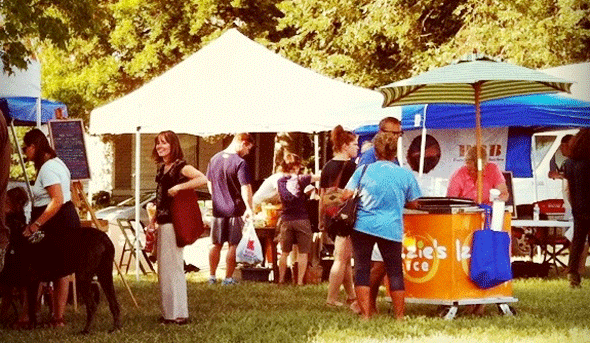
Many newcomers to local fare might not realize how much is available in the the fall. While the choices differ from the summer months, there is still a diversity of good for you and good to eat produce to look forward to trying.    According to Amy Delvin Tavalin, "vegetables will be changing in the remaining weeks- cooler weather brings back the leafy greens along with winter squash, pumpkins,sweet potatoes, broccoli, cauliflower, radish, turnips,  and beets.Some vendors will have fall herbs, flowers, and seasonal desserts as well! 

For Tavalin, the idea of celebrating Autumn in East Nashville is an easy choice:

There's something about the changing of the seasons that inspires community. We're hoping to have the East Nashville community out to help us celebrate Fall and the changes that it brings. Pumpkins, gourds, leafy greens, winter squashes, sweet potatoes, cabbage, broccoli, cauliflower will be making their way in, and that nip in the air that October brings will invite folks to try hot cider, coffee and pie. 

Do you really want to miss this?  That's what I thought. Come out, sample some good stuff and bring more healthy goodies home.  You'll be glad you did! 


Wednesday, August 1, 2012

Flying S Farms: Ten Years of Deep Roots and Strong Values

by Jas Faulkner 

"This is our way of life, it is not a hobby but a living. We love what we do, it is hard work but at the end of the day we know we are providing the best we can grow and helping others learn what real food tastes like and where it comes from, locally!" 
                        -Catherine Simmons,  Flying S Farms


One of the benefits of getting your produce from a true farmers market is that you are buying it  from the people who actually grew what you see on the tables. A visit to each individual vendor can and often does reveal the personalities behind the people who create the places that produce what feeds you. In a way, it's a chance to get a feel for those farms.  Okay, it's not absolutely like being there, but it can be the next best thing. 


The Flying S Farms' retail space at ENFM brings to mind the green, sunny expanses of Cannon County, Tennessee.  It is a treat for the senses. In spite of this summer's challenging weather, everything looks lush and vibrant.  There is the smell of fresh produce, sometimes accompanied by a tantalizing whiff of items from their kitchen.

You will also encounter Catherine and Ben Simmons, the owners and operators of Flying S Farms and Baking Farmer.com.   The Simmons are not only part of that elite subset of farmers who work on sustainable terms with their environment, they act as approachable ambassadors to anyone who is not quite sure why it is so important to support local agriculture.  


Their sense of community and a natural instinct towards education informs much of what they do.   In fact, it was an observation made by a child Mrs. Simmons encountered in a grocery store that inspired her decision to add prepared foods to their products:

"Baking Farmer came about when I was shopping at one of our local grocery stores and during checkout a young child pointed at me and said "Look mommie, there is that farmer lady and she bakes too!" They had been to our local farmers market and shopped at our booth and I guess through the eyes of a child she ?described me; a 'baking farmer'."
Simmons attests doing all of this can put her in the position of educating people about what that farm has to offer:
"You can not just place your produce on a table and say here it is, you've got to promote it. You need to learn what the produce taste like, how to use it, how to store it and where it comes from. People are so far removed from the farm anymore, they don't know what it takes to produce it or how to use it. We are amazed how many people do not know that green beans do not grow cut up!"
Even with the odd customer who thinks their green beans sprout from the ground already French cut, it is encouraging to see the increase in return customers and the growing awareness of the nature of food production and how it directly affects everyone involved in the process.  The Simmons credit the current market manager (Amy Delvin of Delvin Farms) with much of the market's success.

Even though Flying S Farms is a relative newcomer, having started operations in 2002, the Simmons have strong emotional ties to where they work and live.  Catherine Simmons recounts the history of the farm:

"Ben has always been involved in some form of Agriculture since a young child in Arkansas and Mississippi and through the years has worked with John Deere and with row crop farmers in Tennessee in various ways. My background came from parents of the Depression, we always had a garden in our backyard in Arizona. I recall my dad giving me some yellow banana squash seeds to plant in my very own 5x5 plot, we went on vacation for couple weeks and returning home my squash plants had taken over our backyard! He told me I was a born gardener and I had a green thumb because he never dreamed the seeds would even grow. I was hooked. In 2002 Flying S Farms began when Ben and I moved to the farm to care for my mother after the passing of my father. We met a family that market farmed and they encouraged us to make our kitchen garden larger and sell the excess at local farmers markets. We started very small with about 1/4 acre over a couple years making a few more plots I called Ben and told him Flying S Farms was growing, when he got home that evening I had tilled up the rest of the field with drive around plots, there was now 2 acres of growing room. Flying S Farms is still growing on acreage that we lease locally."
The name of the farm is also steeped in family history:
"As a young man, Ben designed a brand for their family farming business, his father was a pilot in WW2 and Ben followed in his dad's love of flying and he used the Army Aircorp Wings as inspiration for their brand."
Fans of "The S" state that the hearts, hands and minds that drive the farm can be seen in the quality of what appears on their tables.  Most of what goes in to the prepared foods they offer from their licensed commercial kitchen is either directly from their fields or provided by local farmers.  Customers can also be confident that the same care goes into their produce.


"We use natural and organic methods of growing our produce, the produce is getting their nutrients from the soil, not from commercial fertilizers. We sow covercrops in the early fall in various locations of our field to turn under in the spring providing the soil with green manure. During the growing season, we cultivate any weeds and grasses that grow between rows back into the soil. All our plants are either direct sown or started from seed in our greenhouse. We grow mostly heirloom type produce, the real thing and the real taste! As for day to day work, that is exactly it, work!"
Want to know more?  Visit Flying S Farms at East Nashville Farmers Market and on the internet at:  

Wednesday, July 25, 2012

A Chick Chick Here and a Chick Chick There


by Jas Faulkner 

Here a chick!
There a chick!
Everywhere a chick chick! 

Depending on who you ask, chickens can be cute and fluffy or big and scary or bug-eating fertilizing phenoms or good friends with egg benefits. For people who have never spent much time around them, they are bit of an enigma.  Their presence as part of Nashville's burgeoning localtarian culture has caused some of the more heated arguments in city council over the past few months.  So what is it about these complex, sensitive creatures that incites so much passionate debate?  ENFM sat down with Mary Self, a Middle Tennessee chicken enthusiast who is quickly turning into one of their most persuasive advocates.

According to Self, there are a number of things to take into consideration when deciding whether or not to keep chickens, not the least of which is location.  Some districts opted out of the current ordinance and others placed restrictions based on the amount of space you have available. 
Per Self:  According to the ordinance there must be a minimum of two square feet per hen provided for henhouses and six square feet per bird for fenced enclosures.
In an urban setting, following the ordinance, the chickens depend on the owner for fresh food and water and protection. No free ranging! I visit my girls 3 or 4 times a day for between 10-15 minutes each visit. I bring them fresh food and water in the morning, they get a few treats a day and then I check them at night to make sure they are tucked in and safe. 
No free ranging means you'll have to provide a coop for your little cluckers. There are retailers offering coops, pens and "chicken tractors" that range from budget friendly basic to palatial in scale and ornamentation.  Ms Self confirms that premade coops can get spendy.
 "Well, that is totally up to the person because some coops can cost hundreds or thousands of dollars, however we built our coop for $400."
The biggest expenses occur at the beginning.  The chickens seem to cost considerably less and and maintenance is reasonable:
"Our chicks cost $5 each and a 50 lb bag of convential feed costs about $20. A feeder and water bottle cost about $10 each. I have also had a few vet visits with my chickens so that adds up quickly. Over time, I don't think it will feel expensive because they are my pets and I love them."
So. You have the cute little house, the safe place for them to play and stuff for feeding and watering and...chickens.  Where do we get chickens?  Self says you can go the traditional route and buy them locally or shop online,   A quick look at hatchery (chickery?) websites reveal dozens of breeds of poultry.  Some are pretty, others are sleekly practical.   It all depends on why you want chickens. Metro ordinances will allow chickens for eggs only.  Self recommends Rhode Island Reds, Barred Rocks, Opringtons, Araucanas, and Marans.  

"I have two Buff Orpingtons, Thelma and Louise, who have been laying an egg almost every day since they turned 6 months old," she added. 

Is it worth it?  Ms Self says the happiness a feathered friend can bring into your life is contagious:
"Where should I start? I love it! I look forward to visiting them during the day. They each have a different personallity and they "talk" to me. Their eggs are delicious. The yolks are a beautiful shade of orange and taste creamy and fresh. I share eggs with my closest friends and some of my husband's co-workers. The girls are not messy and my neighbors love them. I have one neighbor who is currently building their own coop. It's a beneficial relationship, like dogs and cats, but my pets make my breakfast!"
and has inspired an ingenious business idea... 
 "I only worry when I go out of town because it is hard to find someone to care for them. I am actually thinking of starting a chicken sitting service to help others."
Does urban chicken keeping sound like it might be your cuppa?  Join Mary Self and other like-minded fans of our feathered friends at Urban Chicken Advocates of Nashville. UCAN Is a volunteer group that provides education and advocacy for people who wish to keep hens in Metro Nashville. Her hope is that the group can help keep the ordinance alive.  
"Our next meeting will be in September and anyone interested should sign up on our website www.ucannashville.org The ordinance has a sunset clause attached to it and in 18 months it will be up for more discussion and a final vote. If Nashvillains want to have the right to raise hens they really need to communicate with their council members and become a part of UCAN!"
For more information, visit UCAN online at www.ucannashville.org and be sure to say "Hi!" to Mary at ENFM, where she acts as an outreach educator for Nashville Foodscapes.


Wednesday, July 18, 2012

Is A CSA Right For You?

by Jas Faulkner

writer's note:  Apologies to readers who might want to see what a share looks like.  The image application for Blogger isn't working.  Check out the links at the end of the article to get a look at examples of each farm's share.  Better yet, come to ENFM and take a look at the boxes and baskets that are picked up each week by happy subscribers.


You see them every time you visit the market, those people walking to their cars or pedaling home, happy as clams.  They're bearing boxes or baskets that would make Martha Stewart fling herself across her perfectly appointed four-poster and weep bitter tears at the perfection that defies all of her lifestyle maven's logic.  What is the cause of all of that peacock-strutting to the parking lot?  Only one thing could incite that kind of feeling: picking up a weekly share from one of the CSAs at East Nashville Farmers Market.

What is a CSA?
CSA stands for Community Shared (or Supported) Agriculture.  They offer consumers a chance to buy a share in dedicated crops that are delivered on a weekly or biweekly basis.  Most farms offer subscriptions that run from late Spring to mid- to late Autumn. Some farms offer Winter CSAs, which are usually shorter and provide whatever produce is available in the cooler months.  The average share per delivery is around a half bushel of fruits and vegetables.

The costs can vary, but you can expect to pay four hundred to eight hundred dollars per subscription depending on the duration and frequency of deliveries.  If paying that much money at once brings on a case of sticker shock, look for farms that offer early subscription discounts and installment plans. Keep in mind that upfront economy might cost you later on in terms of time, convenience, and gas. Some lower cost CSAs require a commitment to helping with the labor or actually driving to the farm or a designated participant's home to pick up your share. If you're in doubt, be bold about asking for the details regarding delivery and whether you'll be picking tomatoes or waiting in line to assemble your box or basket.

Why should I get a CSA?
I can give you four good reasons.  Siddown.  You're going to like this.

  • Quality - Buying a CSA means you know your pantry is going to be filled with fresh, beautiful produce that was grown fairly close to where you live. The person who hands you your share every week is more than likely the person who grew it and picked it.  They take pride in what they sell and frankly, the nature of the business is that you're supporting them and they're feeding you.  It doesn't get more personal than that. 
  • Well-being - Eating produce that is locally grown means eating plants that have adapted to the soil conditions and climate of your part of the world.  It also means eating with the seasons.  While most ongoing studies are still inclusive, there is strong evidence suggesting mental and physical benefits to eating in tune with your environment.
  • Cost - Remember that sticker price that seemed so big at the start of the article?  Do the math.  If you break down the cost based on the weight of your average share, it comes to around two dollars per pound.  Try getting that much produce for the same price at your local market.
  • It's the right thing to do - Supporting family farming in your area keeps agrarian culture alive for another generation.  By enabling local farmers to stay in business, you also help protect scarily dwindling arable land from disappearing and the ecosystems they support along with it. 

Is this right for me?
Could be.  Do you like vegetables?  Have you been trying to find some way to structure your kitchen management that will help you eat a healthier diet?  Do you like the idea of preparing fresh meals?  Are you the least bit adventurous when it comes to trying new things?  If you answered, "yes" to those questions, the CSA pickup will be a bright spot in your week.

However...and there's always a however, isn't there?  If you're a picky eater who has been known to throw out produce once it starts looking like a lab culture, you might want to continue buying your veggies a la carte.  A share means just what it says, a share of whatever the farm produces that week.  Finding out there is an eggplant nestled among your greens and a half-dozen of the prettiest peppers and tomatoes you've ever seen means you have to be a sport. The fat purple guy is going home with you.  The upside is you might get motivated to learn how to make a killer baba ganoush.

Where do I sign up?

Many of the Spring and Summer CSAs are already underway and few (if any) allow for midseason additions to their subscription lists. It's not too late to look into Autumn shares and get into the loop for next year. For more information, take some virtual trips to the farms that provide CSA deliveries to the ENFM.